
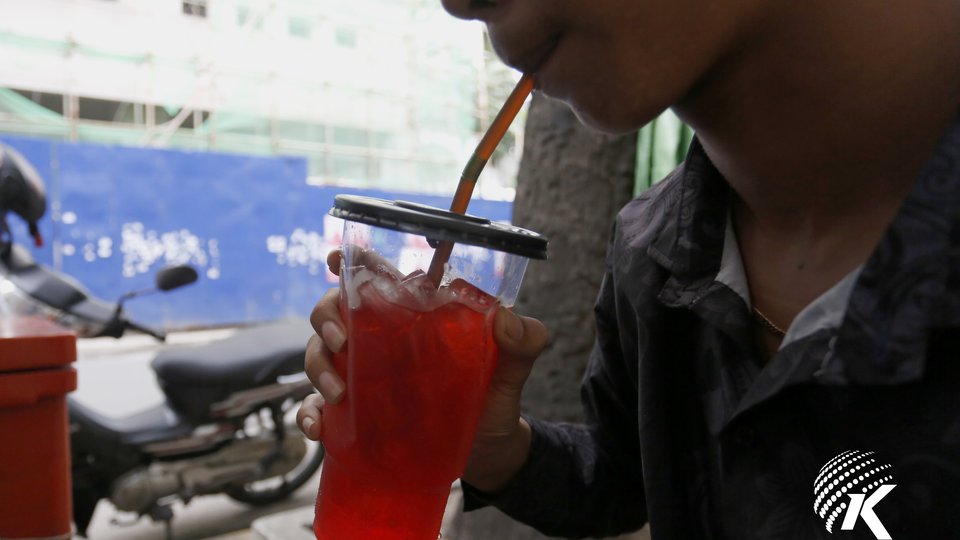
Cambodia Ministry of Education has slapped a ban on the sale and promotion of energy drinks in and around schools to prevent the consumption of highly-sweetened drinks that harm students’ health.
The Ministry of Education, Youth and Sports (MoEYS) issued a new instruction on December 10, 2024 on the ban, instruction schools, educational institutions and relevant authorities to implement measures, such as prohibiting consumption, selling and promoting energy drinks on and off campus, implementing food safety promotion measures and reminding students of educational health messages.
The statement added that any vendors found continuing to sell, the school or relevant authority must revoke the product and terminate their contract.
“To have measures to deal with the actual situation, such as stop consuming, distributing, selling, advertising and confiscating all kinds of energy drinks on the spot and terminating sales contracts,” MoEYs mentioned in the statement.
MoEYs also acknowledged that previous guidelines related to improving health, hygiene and food safety in schools have not yet been implemented.
On Daravuthy, a mother of two children who are in grades 1 and 2 at Chaktomuk Primary School, told Kiripost that the ban is a good thing. She said that at her children’s primary school, the sale of energy drinks has been banned in the school, but outside the school, vendors remain.
Daravuthy noted that this means children who receive money from their parents to attend school can still purchase these drinks.
“Usually, parents who give their children money, they can still buy it. Even if in the school it is not for sale, they can go out to buy it outside,” said Daravuthy.
She mentioned that instead of giving her children money to go to school, she prepares food and water for them and tries to advise them not to eat or drink harmful food and drinks at school. She believes that if all schools follow the guidelines of the Ministry of Education, the ban will be effective.
“If schools follow [the instructions], there will be change, but if there is only an announcement, it will still be for sale. But if the announcement is not effective, we have the next step, going to inspect the location or ban sales [in school],” said Daravuthy.
Ho Sreyrath, a mother of two children in grades 2 and 6 at Chaktomuk Primary School, remains worried about the safety of the food and drinks her children buy at school. She believes that all vendors should stop selling energy drinks at schools to ensure students cannot buy them, and turn to selling healthy drinks instead.
“If the school does not sell at all, we can guarantee that they can not touch the sweet drinks and snacks that affect their health,” said Sreyrath.
Pa Chanroeun, President of the Cambodian Institute for Democracy, mentioned that the previous guidance of the MoEYs has not been implemented yet in some schools. He added that the re-introduction of the guidelines is a good thing, while the ministry should have a mechanism to monitor more school sites.
“Unless there is a mechanism to monitor the implementation of the guidelines and administrative measures to punish those who do not comply with the instructions, the Ministry of Education mechanism will be effective,” he said.
In addition, parents should advise children to reduce the consumption of various energy drinks.
Khoun Vicheka, spokesperson of the MoEYS did not immediately reply to a request for comment on Thursday.
In July, a leading pediatrician found that at least 700 Cambodian children aged between five- and 10-years-old have been diagnosed with Type 1 diabetes.
Daravuthy added that she usually sees children at the age of 10-years-old drink colourful drinks at school. In addition to forbidding sellers from selling, she believes that parents should guide their children from an early age and be a role model for them.
If the children grow up, it may be difficult for them to forbid their children from drinking those high sugar drinks.
“For me, I tell my children from an early age, when they are young, it may be difficult,” said Daravuthy.